Saturday, May 28, 2011

Static Electricity Experiment

They say opposites attract and that couldn't be truer with these fun static electricity experiment. Find out about positively and negatively charged particles using a few basic items, can you control if they will be attracted or repelled to each other?


What you'll need:
  • 2 inflated balloons with string attached
  • Your hair
  • Aluminium can
  • Woolen fabric
Instructions:
  1. Rub the 2 balloons one by one against the woolen fabric, then try moving the balloons together, do they want to or are they repelled to each other?
  2. Rub 1 of the balloons back and forth on your hair then slowly it pull it away, ask someone nearby what they can see or if there's nobody else around try looking in a mirror.
  3. Put the aluminium can on its side on a table, after rubbing the balloon on your hair again hold the balloon close to the can and watch as it rolls towards it, slowly move the balloon away from the can and it will follow.
What's happening?
  1. Rubbing the balloons against the woolen fabric or your hair creates static electricity. This involves negatively charged particles (electrons) jumping to positively charged objects. When you rub the balloons against your hair or the fabric they become negatively charged, they have taken some of the electrons from the hair/fabric and left them positively charged.
  2. They say opposites attract and that is certainly the case in these experiments, your positively charged hair is attracted to the negatively charged balloon and starts to rise up to meet it. This is similar to the aluminium can which is drawn to the negatively charged balloon as the area near it becomes positively charged, once again opposites attract.
  3. In the first experiment both the balloons were negatively charged after rubbing them against the woolen fabric, because of this they repelled each other.

    Biology Facts!

    People who study biology are known as biologists.

    Australia’s Great Barrier Reef is the largest living structure on Earth. Reaching over 2000 kilometres (1240 miles) in length.

    The first person to see a live cell with a microscope was Antonie van Leeuwenhoek, in 1674.

    Ecology is the study of ecosystems and how organisms interact with their environment.

    While some bacteria can make you sick, others have positive benefits such as helping you digest food or even make yoghurt.

    Moulds, yeasts and mushrooms are types of fungus.

    The common cold is a type of virus.

    Viruses can be treated with antiviral drugs.

    Bacteria are extremely small and are made up of just one cell.

    Bacterial infections can be treated with antibiotics.

    Animals that eat plants as their primary food source are known as herbivores.

    Endangered species are those that are in danger of being completely wiped out, they include blue whales, tigers and pandas. Without protection these species may eventually become extinct.

    Born on July 5th 1996, Dolly the sheep was the first mammal to be cloned from an adult cell.

    When the DNA of an organism changes and results in a new trait (characteristic) it is known as mutation.

    French chemist and microbiologist Louis Pasteur was well known for inventing a process to stop various foods and liquids making people sick. Called Pasteurization, it reduces the amount of microorganisms that could lead to disease without having a noticeable effect on taste and quality in a way which methods such as sterilization might.

    Charles Darwin developed the idea of natural selection, sometimes called survival of the fittest. It is a process that involves living things with favorable traits being more likely to reproduce, passing on their favorable traits to future generations.

    Monday, May 16, 2011

    Happy Teacher's Day!

    The Science & Math's Club of SMK Seafield on behalf of every student and the whole school would like to wish all teachers throughout the nation a very Happy Teacher's Day!
    Thank you for all the support, guidance, care, love and patience. Behind every great student is always a determined teacher working his or her socks off.


    To our beloved teacher advisor of the club, Pn. Chuah Lay Suan, and to every teacher out there, thank you. Your sacrifices made the path for our future.


    Happy Teacher's Day!


    Teachers are expected to reach unattainable goals with inadequate tools. The miracle is that at times they accomplish this impossible task.
    - Haim G. Ginott

    Wednesday, April 27, 2011

    Our Very Own Mini Exhibition!

    Two weeks prior to our 7th meeting, the members were given a brief description about the activity that would be held in a fortnight's time. A mini exhibition was to be held and members were assigned to invent their own experiments or at least exhibit something out of the ordinary. They were given two weeks to prepare their idea and to handle the paperwork. Materials and chemicals that were needed were provided by the school lab and members were required to bring their own apparatus. 4 groups were created and as weeks passed by, it was time for our mini exhibition. 
    Preparations were made and the members settled in. The panel of judges for the day were the Pn.Chuah, our teacher advisor and the board of directors. Members were really committed in preparing the exhibits and their final product was equally as good as well. It's time to let the pictures do the talking.


    Food colouring and milk? This ought to be interesting.


    They make the atmosphere so cheerful as they'e always smiling.


    Golf ball with glue. Now that begs an answer.


    Some nice fancy coloured solutions. 


    Packed and ready to demonstrate their exhibit I should say.

    And yes that's what they did. They were the first group to show their work  as the judges started the mini exhibition.

    Ever heard of spinach being an indicator for acidic and alkaline solutions? Well that's what they did. Boil some spinach and crush them into pieces. A spinach solution is formed.

    After testing different types of solutions, it's found that acidic solutions turn the indicator red while alkaline solutions turn the indicator blue.

    Next, we have colour changing milk. 

    Now I see the relation between food colouring and colour changing milk.


    It's an explosion of colour!


    Start with a dark colour.


    Then add a few more colours into the mix.
    Observe how the colours disperse around in symmetrical patterns of wave. It really is an explosion of colour! 


    The crowd gathers to watch the demonstration along with the judges.


    A friction compensated runaway. The ramp is angled in such a way that the rolling ball  stays static.


    One of the judges feeling that little bit excited.


    Pn.Chuah discussing the uses and benefits about their experiments with the members

    Niroshen briefly explaining the use of his experiment along with his partner.

    His experiment exploited the concept of invincibility. Transparent ink  that can only be decoded with white light or monochromatic light. Innovative.

    After evaluating and deciding the best group with the best experiment, the panel of judges announced their results.

    The runner-up of the day's best experiment goes to colour changing milk. Geraldine Lim and Shane Lopez received a prize for their efforts. 
    And the mini exhibition's best group goes to...

    NurNatasha, Norman and Su Jean for their spinach as an indicator solution. Congrats to them!

    All in all, this week's activity was to expose members to the wonders of science. Experiments of all sorts were carried out by members to encourage a positive and scientific mind as well as innovation and creativeness. A job well done. 
    Stay tuned for more with our next post!

    Sunday, April 17, 2011

    Math's Race!

    Since we've been doing quite a number of experiments during our previous meetings, this time we decided to have some fun. This time around, we had a race! A math's race to be precise. The President and Vice President as well as Pn.Chuah along with the members gathered at our usual place, the Avogadro's Lab. Members were then divided into pairs and individuals to compete for the grand prize.


    President and Vice President explaining the rules and regulations of the race.

    After receiving their clues, members were required to solve them.

    They found it!

    Clues yet to be found.

    Can you guess the answer?

    Some of the clues were pretty confusing, I should say.

    Members that found and solved all their clues were told to show the judges. The judges would then decide if their answers are right.

    All 7 clues were requited to be solved and found.

    Geraldine and her partner were awarded as the first team to arrive with all clues solved and found. The grand prize, Cloud 9 chocolates. Yum yum. 

    The winners and runner-ups of the race.

    Monday, April 11, 2011

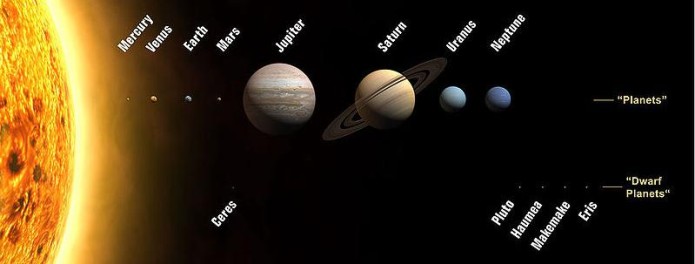
    Space Facts!


    The Sun is a star found at the center of the Solar System.

    It makes up around 99.86% of the Solar System’s mass.

    At around 1,392,000 kilometres (865,000 miles) wide, the Sun’s diameter is about 110 times wider than Earth’s.

    Around 74% of the Sun’s mass is made up of hydrogen. Helium makes up around 24% while heavier elements such as oxygen, carbon, iron and neon make up the remaining percentage.

    Light from the Sun reaches Earth in around 8 minutes.

    The Sun’s surface temperature is around 5500 degrees Celsius (9941 degrees Fahrenheit), so pack plenty of sunscreen if you plan on visiting (remembering that the average distance from the Sun to the Earth is around 150 million kilometers).

    The Sun’s core is around 13600000 degrees Celsius!

    The Sun generates huge amounts of energy by combining hydrogen nuclei into helium. This process is called nuclear fusion.

    Because of the Sun’s huge influence on Earth, many early cultures saw the Sun as a deity or god. For example, Ancient Egyptians had a sun god called Ra while in Aztec mythology there is a sun god named Tonatiuh.

    The Sun produces a solar wind which contains charged particles such as electrons and protons. They escape the Sun’s intense gravity because of their high kinetic energy and the high temperature of the Sun’s corona (a type of plasma atmosphere that extends into space).

    Planets with strong magnetic fields such as Earth manage to deflect most of these charged particles as they approach.


    A solar eclipse occurs when the Moon is between the Sun and the Earth.

    While we usually think of the Earth’s Moon there are many other moons in the Solar System.

    As of 2009, there were 336 moons in the Solar System. 168 of these orbit planets, 6 orbit dwarf planets, while the rest orbit asteroids and other Solar System objects (many yet to be classified).

    Jupiter’s four main moons are named the Galilean moons (after Galileo Galilei). Their names are Io, Europa, Ganymede and Callisto.

    Io features over 400 active volcanoes.

    Some scientists believe that water could exist below the surface of Europa.

    Ganymede is the largest moon in the Solar System.

    Callisto has a similar diameter to the planet Mercury but only one third of its mass.

    Saturn’s largest moon is named Titan, it is the only moon known to have a dense atmosphere.

    Neptune’s largest moon, Triton, is similar in size to Earth’s moon. Discovered in 1846 it is the seventh largest moon in the Solar System.

    The largest moon of the dwarf planet Pluto is named Charon, it was discovered in 1978 and has a diameter that is around half as wide as Pluto’s.

    Mars has two moons named Phobos and Deimos, both were discovered in 1877.

    Venus and Mercury have no moons.

    Tuesday, March 29, 2011

    The Launching Of The Science And Math's Exhibition!

    It's finally here! The update about the Science And Math's Exhibition! So let's get straight into it.
    On the 22nd of March, the Science And Math's Exhibition of 2011 was officially launched by our very own principal, Pn. Hajah Zaleha. This event has been held every year for the past four years in conjunction with Science And Math's week and this year's edition came in with more fantastic and wonderful ideas.


    The President of the club decided to give a speech before the ribbon-cutting ceremony.


    Harsukhpreet Singh, President of The Science & Math's Club 2011

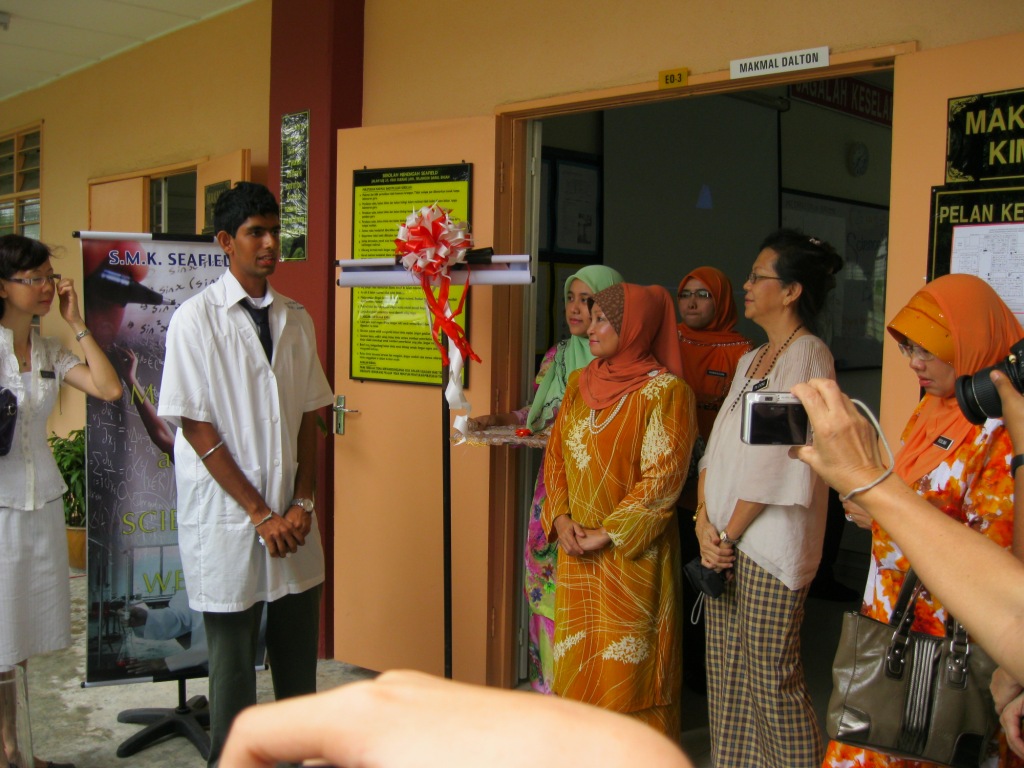
    Pn. Hajah Zaleha, accompanied by Pn. Loy start proceedings by cutting the ribbon.


    The Science & Math's Exhibition of 2011 is officially launched!

    Head Prefect, Kaelan Ong planned a opening ceremony experiment to kick off the exhibition with a bang!

    Kaelan explaining the 'Elephant Paste' experiment and its outcome.

    With a bit of potassium iodide poured by Pn. Zaleha into the mixture and there you have. Foam galore!

    Let's start off the exhibits with water from the heavens.

    The name says it all. Water from nowhere!

    Next, we have Simple Distillation. This experiment creates ester which has a fruity smell or also known as perfume. The students in charge of the experiment came up with a variety of 'perfumes' which really smelt good.


    Cloud In A Bottle?


    Andrew explaining the process of the experiment step by step. "When pressure is optimum, the bottle experiences immediate condensation.......".

    Qualitative Analysis Of Salt. Now for those of you who are familiar with this 4 words, you'd know they're all about salt compounds learnt in Chemistry when you were in Form 4. Forgot about it? Chapter 8, read up!

    Jared giving a brief explanation about salt compounds and their changes when reacted with other substances.

    Melisa Chan of 5 Damai having a game of math riddles with Pn. Zaleha

    Bending A Bone & Bouncing An Egg


    Vinnith of 5 Damai as well explaining how to bend a bone to the teachers.

    Math games are fun!

    Pn. Zaleha having fun trying out math games.

    Zero Zorro!

    This software teaches you how to play sudoku. Ain't that cool!


    Pn. Zaleha & Pn. Chong competing against each other in a game of sudoku.

    Instant Ice? Now that's cooooool.


    It takes a few seconds before the ice is formed. Science at work.

    Ever wanted to know what makes slime so slimey? Search our January post on how to make slime.


    They're having fun!

    Nasheel Kaur, also from 5 Damai demonstrating the use of slime as a stress releasing material. 

    Centre Point Of Gravity? Point Of Equilibrium? Stability? All thanks to gravity!


    Transport Of Water In Plants.

    Jon Ho from..... yeah you guessed it, 5 Damai explaining how water travels in plants.


    Immerse the stem of the flower in a certain coloured solution, in this case blue and you shall get a flower with blue petals. Ain't that gorgeous?

    Dynamo Revolution! Arguably the most entertaining experiment throughout the exhibition.

    Hot on their wheels.

    Pn. Chong in pursuit!

    Here's a video of Pn. Chong trying out 'Dynamo Revolution'


    Pn. Zaleha joined in the fun and raced against Pn. Viani.

    Here's another video. This time it's Pn. Zaleha against Pn. Viani.


    The team behind the track. Aaron Lui & Andrian Tham.

    Elephant Paste. Yeap, this paste seems familiar. This was the opening ceremony experiment which kicked off the exhibition in style.

    Watch the clip above and see how the foam unfolds itself.

    Rainbow coloured foam. Sweeeet.


    Water Rocket & Coke Fountain! Both of them surely enough sound like fun.


    Pump harder! Pump faster! 3, 2, 1........ we have lift off!


    The crowd overjoyed watching the rockets fly high.
    Pn. Zaleha then opted to give one of the bottles a blast off by volunteering herself to pump the rocket.


    Pn. Zaleha in action.
    And finally, Coca cola fountain! Add a few mentos sweets into a bottle filled with coke and you'll get a fountain! Don't believe me? Watch it for yourself.


    I'm sure you're planning to try this one out right now. Hahah, well then what's stopping you?!

    Overall, The Science & Math's Exhibition this year was deemed a success. With outstanding experiments and fascinating demonstrations, this year's edition was all in all superb. Wanna see more of our experiments? Stay tuned for part two where we're gonna show you all the experiments bit by bit! So don't go for too long. We'll be back soon!